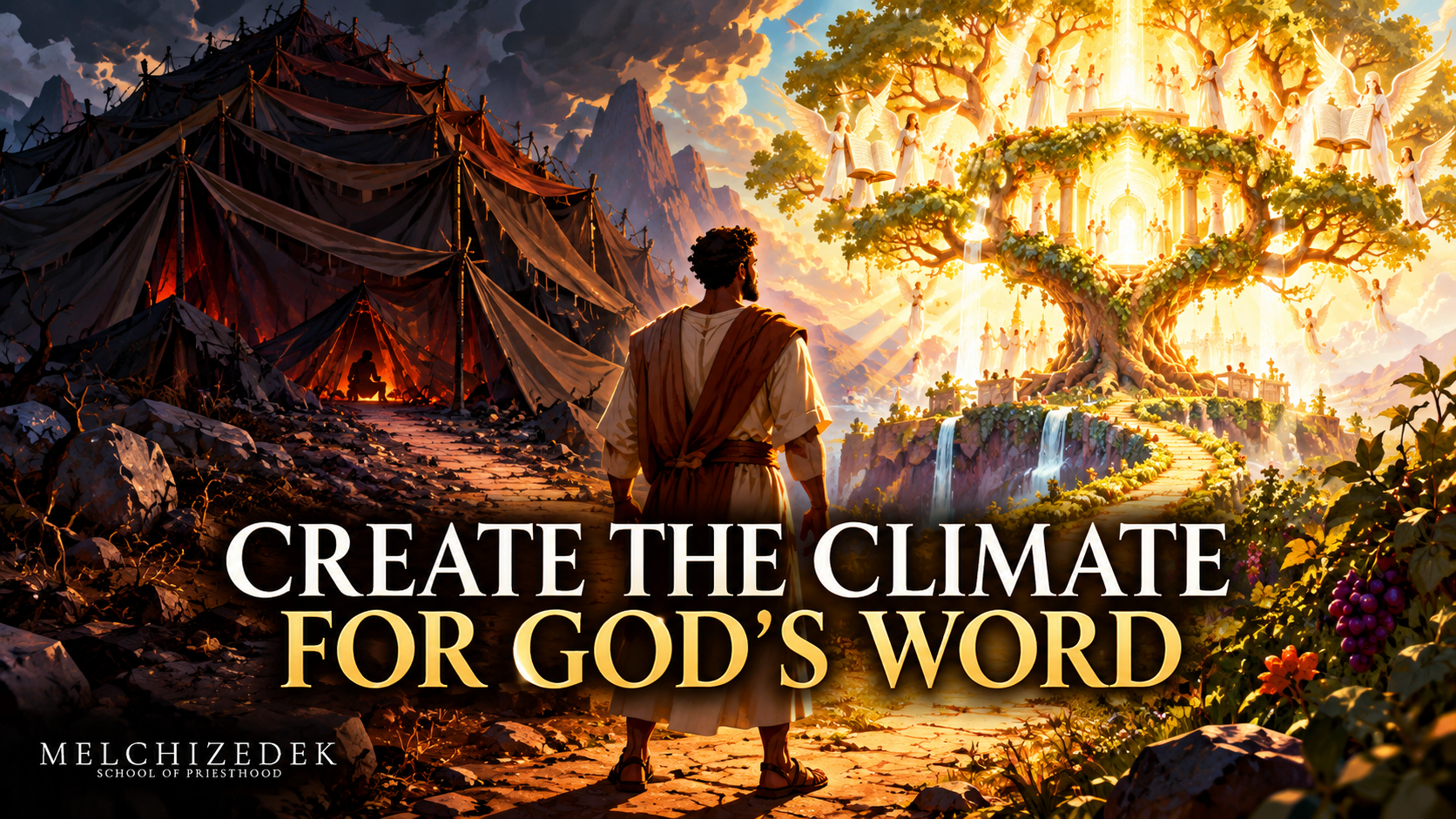
Building a Tabernacle Through Repeated Encounters with God
Francis Isibor Jr
Source:
Melchizedek School of Priesthood
Oct 8, 2026 • 1 view
Francis Isibor • October 2, 2025 • 170 views
This analysis begins at 10:36, the first available caption, and does not reconstruct the preceding uncaptioned interval. Worship leads to prayer for truthful utterance and receptive hearts. The title-named teacher, Francis Isibor, says the session will expand what was delivered at the conference and cover what could not be fully taught there. He reviews covenant, kingship, priesthood and sonship, with servanthood announced as a later theme. A description of blood covenant leads to communion and to relinquishing the old life for Christ’s life; the speaker himself makes that metaphorical explanation. Isaiah 9:6-7 supplies the distinction between a child born and a son given, which he interprets as deliberate formation before public presentation. Nativity shepherds, Abraham and Isaac, Samson and John the Baptist become examples, though several accompanying historical and doctrinal claims are his own interpretations. The teaching moves from Abraham and Sarah’s shared obedience to altars, Jacob’s encounter, the tabernacle and ascent, using Psalm 24 and a speculative DNA/stairway analogy. John the Baptist is then presented as carefully prepared for an assignment: Luke 1 is read, repentance must produce fruit, and John accepts his subordinate role in relation to Jesus. An audience member asks whether the age of thirty is required for sonship today. Isibor answers that physical age is not the criterion; people begin their Christian life at different ages and growth is spiritual. Jacob and Esau illustrate valuing inheritance, with an imagined conversation expressly acknowledged as storytelling. Romans 8:12-17 grounds the concluding appeal in Spirit-led life, adoption, inheritance and shared suffering rather than the dictates of the flesh. The subsequent discussion is substantial. One participant questions why programmes and spiritual gifts have not produced the maturity being described. Isibor replies that maturity is intentional and personal, warning that trying to carry everyone can obstruct one’s own growth, while also saying those who mature should make a way for others. Another contribution stresses commitment, suitable teaching and Christlike witness rather than mere motivation; further voices emphasize skill in ministering life and sustained intercession. The final exhortation rejects dependence on a celebrated minister as a substitute for personal responsibility and defines inheritance as the incorruptible life and nature of God, not money. A closing leader prays for self-examination, the Spirit’s help, obedience and communion, including petitions for strength and healing that are not guaranteed outcomes. Songs, fellowship announcements and an explicit dismissal close the available segment, with music continuing afterward.
Study note: Caption-based study. Scripture references include explicitly cited passages, speaker allusions and editorial supporting connections. Prayer points are editorial reflections, not verbatim quotations. This is a bounded-source study; it does not cover the entire original meeting.
Wholehearted surrender. Father, help me respond to Christ’s gift by yielding harmful habits and receiving your life with gratitude.
Willing formation. Teach me to grow in obedience and wisdom rather than look for a title or age that guarantees maturity.
Faithful inheritance. Lead me by your Spirit and help me value what is lasting above immediate appetite.
Maturity for service. Make my growth fruitful in patient service, intercession and responsibility toward others.
Francis Isibor Jr
Oct 8, 2026 • 1 view
Francis Isibor Jr, Francis Isibor Snr
Oct 1, 2026 • 1 view

Francis Isibor Jr, Francis Isibor Snr, Samson Ototobor
Sep 24, 2026
Chuddy Ubajekwe, Francis Isibor Jr, Samson Ototobor
Sep 17, 2026 • 11 views