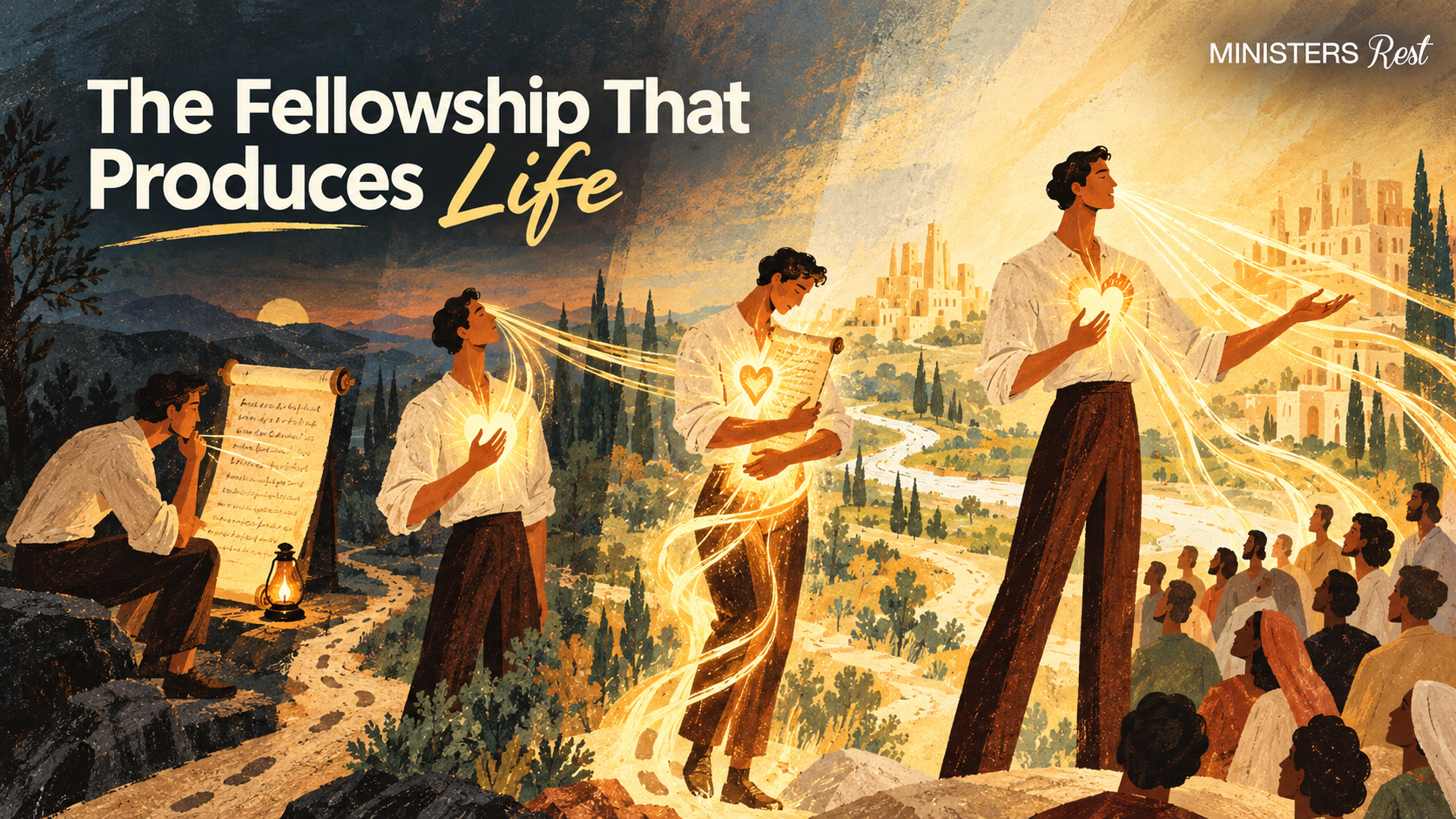
The Life of Christ Expressed Through True Fellowship
Clever Odiah, Samson Ototobor
Source:
Ministers Rest
Oct 5, 2026 • 1 view
• September 15, 2025 • 126 views
The surviving recording begins mid-discussion with a question about whether love is lacking in the church. Participants resist sweeping judgments and distinguish charitable acts, inner character and the daily practice of love. One reads 1 Timothy 4:8-12 to stress being an example, then recounts conflict with a younger brother over a property gate; another challenges the delay in reconciliation by invoking the command not to let the sun go down on anger. The reply distinguishes forgiveness from making an offender understand the harm. A further testimony alleges that an unnamed church neglected urgent eye-treatment needs while funding projects, whereas friends paid for surgery. This material is contested testimony, not a verified account. At 47:29 the discussion pauses for conference accommodation, transport, construction, volunteer and prayer planning. On returning to the subject, speakers debate corrective love, forgiveness, hearing God during anger and developing self-control. Personal road and family incidents illustrate different stages of maturity; one participant describes past physical retaliation, after which others explicitly say not to bite or assault anyone. A later response says the same loving character should govern treatment of believers and unbelievers, while allowing boundaries and lawful protection against persistent harm. The main extended contribution reframes the issue around a kingdom community built through mutual service, or “one anothering.” John 13 and 15 support love and foot-washing; 3 John’s Diotrephes becomes a warning against self-importance, exclusion and wealthy donors controlling a congregation. The speaker also gives contested historical and theological explanations of Nicolaitan control and church structures, which remain attributed interpretations. The later discussion proposes a family-and-community reading of women’s silence in 1 Corinthians 14:34, but fuller treatment is explicitly postponed. A participant then asks whether an ecclesial or kingdom setting makes people immune to ordinary human failings. The reply clarifies that the framework does not make people perfect; it is intended to form Christ’s life within them. Genesis 4:7 is recalled to emphasize warning, choice and consequences, and the closing exchange compares personal formation with stones being shaped for a temple. A clarification about Christ’s high-priestly presentation is brief and is not expanded beyond what survives. Conference prayer scheduling, letters, lodging and contributions follow, then communion thanksgiving and explicit dismissal at 2:52:54-2:53:03. The bounded lesson joins inward formation with mutual care, clear correction and non-retaliation, while preserving unresolved disagreements and excluding the unknown opening and long postdismissal tail.
Study note: Caption-based study. Scripture references include explicitly cited passages, speaker allusions and editorial supporting connections. Prayer points are editorial reflections, not verbatim quotations. This is a bounded-source study; it does not cover the entire original meeting.
Practical love. Editorial prayer: Jesus, form love in our conduct and make us attentive to concrete needs.
Patient correction. Editorial prayer: Lord, help us name harm truthfully, forgive and pursue safety without retaliation.
Mutual service. Editorial prayer: Father, free our communities from self-importance and help us serve one another.
Humble growth. Editorial prayer: Holy Spirit, shape our emotions and relationships with patient wisdom.
Clever Odiah, Samson Ototobor
Oct 5, 2026 • 1 view

Francis Isibor Snr, Samson Ototobor
Sep 28, 2026 • 1 view
Clever Odiah, Francis Isibor Snr
Sep 21, 2026 • 1 view

Francis Isibor Snr, Samson Ototobor
Sep 7, 2026 • 3 views